Showing posts with label CLF Civil Liberty and Faith. Show all posts

Friday, November 2, 2007

Trangdai Tranguyen on the fires in southern California

Firing up the Voices
by Trangdai Tranguyen


The air smells of death. The silence tastes morbid. The sky stops breathing. The ocean becomes distant.

On the balcony strewn with crunchy green leaves and inundated with suffocating ash, the plants and flowers let their leaves off, begging for water respite and CPR.

My nose is bleeding. The same way my heart bled on the empty endlessness of New Orleans freeways, in the boundless blankness of Biloxi neighborhoods, at the fathomless frustration in which disadvantaged Louisiana residents swayed. Months after the hurricanes, green trees pushed elbows with half-witted houses and dangling street lights, as if mocking, as if inviting, as if challenging.

Renters returned home – for they had no where else to go, or could not come to part with that piece of their heart. But there was another piece that they needed. A piece of paper.

A piece of paper is everything. Without it, they no longer exist. It is their life – which they no longer have. Elderly men displaced by wars, then displaced by flood, asked for assistance. They stood in line day in day out, only to be sent home empty handed from the relief stations overflowing with donated goods. Immigrant fishermen came for emergency stipends. They were told that their 'number' could not be located. A place of destruction: that was all they had. Nothing more.

Not many others came back. Yet those who took the risk to return home found themselves deprived of the aids that were reserved for the 'legitimate' who had safely relocated else where in their relatives' homes. Safely. Long ago.

Water. Fire. Different? Maybe so from aerial views. On the ground, the pattern repeats. On the ground, real things happen. It is the human life that is at risk, the marginal voices that resonate into thin air, the inequitable distribution of aids that persist, the refusal to acknowledge that certain lives have value, the violence of perpetuating discrimination.

These lives are not irrelevant. They get fish from the sea to the dock. They get food on the table. They clean the sheets. They water the plants. They build the freeways. They drive the trucks. They are the hands that craft tomorrow and the feet that move today in the most organic way.

Though they are treated as replaceable goods, they are not disposable. They are humans.

They are life.
Trangdai Tranguyen is a member of PANA's Civil Liberty and Faith Think Tank.

Tuesday, October 23, 2007

Dr. Gordon Lee on Rekindling the Fire in our Hearts

Capturing the Moment by Rekindling the Movement of the Heart
An API Faith and Justice Gathering
October 20-21, 2007
http://www.psr.edu/pana.cfm?m=302

Reflections by Gordon Lee

On October 20 and 21 a group of folks met at the Pacific School of Religion in Berkeley, California. People shared personal stories, anecdotes. Being together we talked, laughed, ate, got to know and to be ourselves with each other. Some were surprised to find so many connections in the room. Some found a new sense of belonging. Many felt validated in an Asian American and Pacific Island space. We found warm hearts, openness, diversity in unity, be-longing with different ages and ethnicities. Meeting people in our communities who shared visions and concerns, we experienced a new culture that brought us closer together.

It was a rich experience. A lot of interesting things happened. But it was not always easy to analyze or to verbalize. Perhaps it was part of the beginning of a beginning – feeling the pain and identifying the needs of a part of our local communities – awakening our longing for communitas, a pueblo unido, a place where justice, faith, and our humanity can meet and be – and getting just a taste of what it might be like to be in such a community.

Saturday was intense. We began by remembering, recognizing that we are standing on the wisdom and suffering of others, past and present, and on the individuals and movements that have come before us through a beautiful visual meditation prepared by Rev. Israel Alvaran. The first session of sharing our deep longings as people of faith and justice was very revealing, and it took a lot for people to expose themselves. People felt a willingness to be open to new experiences, and it was received with compassion and care.

Saturday afternoon’s session expressed pain, fear, support, and intimacy. Colleen “Coke” Tani- Nakamoto and Elizabeth Leung carefully led us through a practice of revisiting our bodies as sacred sites, the places where seven generations of wisdom, racial trauma, and resistance are carried. For some, it opened up spaces of connection, yet, at the same time, exposed the alienation and suffering, grieving and pain, that we are often numb to or in denial of (the stuff that gets in the way). It was powerful to have that space and to become one movement, focusing on our similar struggles and stories of suffering. As one person said, it was a privilege and honor to share the raw emotions that came out and to be able to respond to them. Sometimes, you could just feel and didn’t have to say anything. What was important was to know that people heard and understood. To feel that it was real and tangible.

On Saturday afternoon it was important to be able to hear and recognize those among us who are living a working class reality. Seeing and hearing their situations helped others put a mirror to themselves. In response, some of us asked ourselves, can we walk away from our past and live a middle class lifestyle? Or, do we hold onto that core of experience that shaped us and our families? To some extent we still live in a working class reality because it is a part of our core identities, but we sometimes forget. It reminded us about who we are, and it helped us to remember a sense of a common class struggle.

For some Saturday had reaffirmed their sense of “calling” and “grabbing something and taking hold of it.” For others it created an opportunity to look inside. To realize that we don’t often get to do this, even in movement work. For others Saturday made us mad but also sad as we realized how lacking is the soul and the spirit of our common ground. I hear you, I see you, is no longer a part of our vocabulary, our day to day life. That belonging as a part of a family– the sense that you might screw up, but the knowing that we’ll work it through - is hard to find. The feeling that you’re not alone, that there’s something beyond that, a sense of loving and caring.

On Sunday morning, it was as if a new energy had entered the room. There was a sense that the previous days had not just focused on goals, but was a pause that allowed everyone to breathe and reflect. Through the sharing of pain and wisdom our collective spirits had become more tangible. With this spirit we anxiously broke into small groups to share our practices of the heart—practices of integration that sustain us and foster life. After the discussions, we reflected told our stories, about the state of our communities, about the challenges of our times, and about where we want to go.

Eleazar Fernandez pointed out that the causes of our suffering are not just external but within us as well. That’s often why they are so hard to address and get rid of. He also noted that this gathering was part of an emerging movement. Most significantly, he asked us, how do we learn to deal with the “stuff that gets in the way?” How do we deal with our internalized shadows? How do we develop a praxis of the heart. What does this mean for and how does it help organizations and individuals in the social justice, faith, and Asian American and Pacific Island communities?

Lloyd Wake was moved by the weekend, especially of the stories and experiences of younger people. He pointed out that the experience and expressions of spirituality of younger generations are not only meaningful to them but also to older folks. Lloyd felt that he learned a lot from and came to a deeper appreciation of the younger community.

Most of all it was the willingness of the participants to engage in different and sometimes uncomfortable ways that created a liberated zone. As Aurora Morales (1998) wrote: "A stance of opposition creates a liberated territory, a psychological space in which we can act on the belief that we deserve complete freedom and dignity even when achieving such freedom collectively is still out of reach. The refusal to cooperate with our dehumanization even when we may not yet be able to stop it is the most essential ingredient of our liberation."

Dr. Gordon Lee is PANA's 2007-2008 Civil Liberty and Faith Visiting Scholar.

Monday, September 17, 2007

Akiko Miyake-Stoner on Women's Voices from the Philippines

"Voices from the Philippines" was a public event of the WGS Sixth Annual International Meeting, "Women Resisting Militarism and Creating a Culture of Life," sponsored by Women for Genuine Security and PANA Institute’s Civil Liberty and Faith Project. This meeting brought together internationally recognized women activists from South Korea, Japan, Okinawa, the Philippines, Guam, Puerto Rico, Hawai'i and the US to build and sustain a network of women, and to promote, model, and protect genuine security in the face of militarism.

PSR student Akiko Miyake-Stoner reflects:

Looking back to my journal entry written after the program with the Filipino women against US militarism, I remember how affected I was by the power of these women. The journey through poverty, humiliation, disrespect, and loss that they have experienced was a powerful testament to the resilience of the human spirit for me. To have such spirited dedication and empowered commitment in the looming presence of the US military inspires me.

One thing I was really struck by was the plight of Amerasians in the Philippines. One woman shared her story of falling in love with an US serviceman who led her to believe he was in love with her, too. While he was stationed in the Philippines, they developed a relationship, writing love letters and seeing each other periodically. Soon after she discovered she was pregnant, he confessed to her that he was married.

This woman shared the bittersweet pain she had when she gave birth to a girl, her Amerasian child. She told us how she struggled to provide for her daughter, but her earnings were not enough. Wanting the best for her daughter, her last resort was to send her girl to live with her father, the US serviceman; she hoped that by giving her up that her daughter would be given adequate food, shelter, and education. It turns out that the US serviceman’s wife was verbally and psychologically abusive to the girl and would not allow her to be in touch with her mother. Ultimately, this Amerasian daughter did not have a home in either the United States or the Philippines because of the stigma attached to her situation. This struck a personal chord for me, coming from a Japanese and German American background. Although I have experienced the bewilderment and confusion of not fitting in with either the Japanese or Euro-American communities, I cannot imagine the pain and self-identity crises of the children of Asian women working in prostitution and US servicemen.

When I left that evening, I felt both very disheartened and complacent, but also so uplifted by the open spirits of the women. There was a powerful gift in the embrace that happened with the sharing of stories; we engaged each others’ humanity as we were present in telling and receiving tales of our pain and empowerment. They implanted in me a subtle sense of freedom: freedom to see beyond my limited ideas of what I think is possible (for me and for the world) as well as a freedom to grow and learn as a fellow world citizen. Ultimately, the memory of this strong group of educators and leaders I encountered that night continues to invite me to be more human as I keep learning about US militarism and other issues that affect people around the world, as well as grow into the potential with which God has created me.

I was struck by the women’s willingness to share their stories, inviting me to be more human as I learned about their stories. To make a change where they can. To meet people one at a time and build relationships with people.

Akiko Miyake-Stoner began her Master of Divinity studies at Pacific School of Religion in the fall of 2007.

Saturday, September 15, 2007

Sister Song

By Colleen “Coke” Tani Nakamoto, September 15, 2007. Dedicated to the WGS women of the 6th International Gathering, “Women Resisting Militarism and Creating a Culture of Life,” San Francisco, CA.

Sister Song

My Dear Sisters—

Your stories, information, creativity and actions have blessed me in places I didn’t know I could feel blessed.
Where in my body can I hold such fierce love?
How can I possibly respond?

The American in me says, By Stepping Back.
My Okinawan and Japanese blood says, By Stepping Forth.
So I step forward, and I step back.
It’s often an invisible and clumsy dance, but one I am determined to learn.
Inside my body, puzzle pieces collide & repel—
You are this. No, you are this. No, you are this!

Say I have two roots. Say my left foot is rooted in Okinawa. Say my left foot is what I inherited from my mother, and from hers, and hers.

Say my right foot is rooted in Japan. Say my right foot is what I inherited from my father, and from his, and his.

Say from the outset, born in America, my left and my right were planted in hopeful but stolen soil, watered from a poisoned well.
Say the sky-birds came and stole my tongue when I was sleeping.
How I ache to be able to talk with you.

Step forward.
Step back.

Say my left foot became fractured when my Okinawan grandparents became plantation workers in Pu’ukolii, Maui. Say my left leg became weak when Pioneer Sugar Mill displaced Kanaka Maoli and overran the land. Say my left arm became crooked when the plantation paid wages scaled by skin and race, Portuguese and other Europeans at the top, followed by Japanese, then Okinawan, then Filipino then Hawaiian. Say my left arm broke when my grandpa beat my grandma, confused by his own dislocation. Say one day, thirty years later, I was born, simply, “Sansei.” Say “Japanese-American.” Say, What’s missing? Say, “Grandma?” My left side buckles.

Say my right leg became deformed when Pearl Harbor was bombed by Japan, and fed the pre-existing hatred toward Japanese-Americans. Say my right foot grew infected even before this, when Pearl Harbor was claimed as a base. Say my right leg cried, when the fish and flora died. Say my right leg still cries for the baby shark met, saved by Summer & Auntie Terry—the baby shark who can no longer thrive there. Say its wide open mouth is like my own, desperate, derailed and displaced by a desecrated Pearl Harbor, and the bomb that blew up the dreams of my people. Say Poston Internment Camp. Say countless places on earth are shattered, villages burned, men believing they are gods.

Step forward.
Step back.

Step forward—
Now say Shellmound, ancestors, recognition. Say ‘ike.
Say Waikiki, Ala Moana, Mokapu.
Now Say Richmond, Say military-industrial complex. Say oil. Say fenceline.
Say Chevron, Say Hanjin, Say Halleburton.
Say asthma, cancer, Say Down’s Syndrome,
Say my granddaughter has a hole in her heart.
Now Say Bayview. Say it’s safe to eat ¼ of ¼ of ¼ of 1 fish.
Say Parcel B, Say Parcel E1, E2,
Say mercury, asbestos, say arsenic.
Now Say Nicole. Say VFA. Say Subic Bay. Say “Commercial Gateway.” Say Extra-
Judicial Killings. Say Military Sexual Terrorism.
Say poverty, say child labor, say exported labor, say trafficking.
Say, They come back “dead or mentally broken.”
Say Where Is Smith?
Now Say Pyeoungtaek Village. Say 3rd expulsion.
Say National Flag Act. Say Military Culture, and Military Camptowns.
Say with Dohee Lee—I had a dream there was a woman standing still, she was trying
to say something but I couldn’t understand…
Say, “Feminist activism is not based on spectacle.”
Say, “My Sister’s Place.”
Say, “onni.”

Step forward—
Now Say, “DMZ Hawai’i.- Say Aloha ‘Aina.” Say Clean Up, Not Build Up.
Say Land Grab. Say Stryker.
Say 1898. Say Makua. Say Pohakuloa. Say UARC.
Say Kumulipo. Say Sovereignty.
Now Say Baguanamay—Say Doña Maria.
Say Aldonza Angoleña, Luisa Capetillo, Antonia Martinez Lagares
Say Zaida, Say Liza, Say Mitzie.
Say Vieques.
Say non-war toys for Luisito!
Say Centro Mujer y Nueva Familia.
Say ilé! Consciousness-in-Action!

Step forward.

Now Say Guahan. Say matrilineal society!
Say hydrogen and atomic bomb testing.
Say downwind. Say air and water currents. Say radiation off the Geiger counter.
Say decontamination and Marine relocation.
Say Chamorro Self-Determination.
Now Say, Keystone of the Pacific. Say 62 years. Say Henoko Bay, Say Dugong.
Say deployment.
Say sexual violence and supposed readiness for military combat.
Say war crimes.
Say coral.

Step forward.

Say, We must recover what was inside of us.
Say, It must be about Resistance PLUS Healing.
Say, Ancestors, Say Spirit.
Say, Mentor.
Say, Unai Festival, and Unai Method.
Say Use Hawai’i media.
Say Peace Guides.
Say Prayers.
Say Good Luck Charm.
Say We Define and Love Our Own Ways of Resistance.

Step forward.

Say, Sister. No, Sing it.
Sing Sister-Who-Restores-My-Whole-Body
Left to Right, Root to Crown
Puzzle pieces sewn together with the thread of an insistent, awakened Love—
The map is the map of Sisterhood, and the treasures are Restoration, Self-Deterimination
and Peace.
Sing Okinawan Sister, Ohlone Sister! Sing Puerto Rican Sister, African American Sister! Sing Korean Sister, Chamorro Sister, Shoshone Sister, Kanaka Maoli Sister, Filipina Sister, Mexicana Sister, Xicana Sister, Japanese Sister, Vietnamese Sister, Cambodian Sister, Salvadorean Sister, Chinese Sister, Nicaraguan Sister, American Sister.
Sing Infinite Sisters.

Step forward.

Sing I Come From…
Sing The Gift I Bring Is…
Sing The Gift I Am Is…
Sing The Gift We Are Is…
Sing.

Saturday, September 1, 2007

PANA Takes on Human Rights Abuses in the Philippines

By Richard Lindsay. Article first appeared in PSR Bulletin, Fall 2007.

PSR’s Institute for Leadership Development and Study of Pacific and Asian North American Religion (PANA Institute) has taken an international role in raising awareness about recent human rights abuses in the Philippines.

In the last five years, Philippines human rights groups have reported that hundreds of unarmed citizens have been killed or have disappeared under the administration of President Gloria Macapagal-Arroyo. This level of killing and kidnapping of political enemies is higher than at any point during the Marcos era. Twenty-seven Christian clergy and church workers of the United Church of Christ Philippines, United Methodist Church, and Philippine Independent Church (IFI) have been killed. Most notably, IFI Bishop Alberto Ramento was stabbed to death in his rectory in October 2006. Human Rights Watch has issued a report accusing Philippines armed forces of carrying out some of the killings in response to left-wing challenges to the Arroyo government’s authority. A U.N. investigator has echoed this conclusion.

Numerous American church bodies, including the General Synod of the United Church of Christ, the General Assembly of the Presbyterian Church U.S.A., the Northern California- Nevada Conference of the United Methodist Church, and the National Council of Churches USA, have issued resolutions or statements condemning the killings and calling for investigations.

PANA’s involvement in speaking out against these acts of violence and repression began with co-sponsorship of a Pagsambang Bayan, or “People's Worship,” a “Service and Candlelight Vigil for the Disappeared and Killed Religious and Community Leaders in the Philippines.” The service was held at Daly City United Methodist Church on December 10, 2006 in conjunction with International Human Rights Day. (Daly City is home to the largest concentration of Filipinos in the United States.)

The effort is part of PANA Institute’s Civil Liberty and Faith Project, now in its second year, sponsored by the Luce Foundation. The goal of the project is to amplify the voices of progressive Asian American and Pacific Islander (API) religious leaders and communities engaged in the work of increasing civil liberties and bringing about greater inter-ethnic and inter-religious understanding. According to PANA Program Director Deborah Lee, “One of the important objectives of this project has been to experiment and create authentic forms of API public witness and model a new way of doing faith-based political expression that is rooted in API culture and spirituality.” Speaking of the People’s Worship, Lee said, “These and other liturgical forms have created sacred containers for people to gather, to advocate and to be spiritually renewed.”

On February 13, 2007, PANA Institute hosted an event at PSR with Bishop Eliezer Pascua, General Secretary of the United Church of Christ in the Philippines (UCCP), who reported on political killings of clergy, journalists, human rights workers, and activists. The UCCP has been the hardest hit denomination in the purge; Bishop Pascua told personal stories of 16 clergy and religious workers killed as a consequence of their ministries.

On March 2, 2007, PANA co-sponsored ecumenical vigils on World Day of Prayer, in Sacramento and at the Philippine Consulate in Washington, D.C., focusing on the human rights abuses in the Philippines.

Efforts of PANA and other organizations led California Senator Barbara Boxer to hold a Senate hearing on human rights and “extrajudicial killings” in the Philippines, which took place on March 14th, 2007. Moved by the testimony of human rights organizations about the murdered and “disappeared” individuals, Senator Boxer stated the need for the U.S. government to act. “We don’t want another El Salvador here,” Boxer said. “We don’t want blood on our hands.”
On June 10th, 2007, PANA co-sponsored another Pagsambang Bayan at Pinole United Methodist Church in commemoration of Philippines Independence Day called, “Narratives of Betrayal, Suffering, Faith and Voice.” The service featured testimony by a 17 member fact-finding team from the California-Nevada Conference of the United Methodist Church, which investigated the current rash of killings and abductions in the Philippines.

“This repression and abuse dates back to the Marcos era, and when the Philippines were dominated by U.S. colonial and military rule,” Lee said. “Today the U.S. war on terror is having a chilling effect on our Christian counterparts in the Philippines.” (The U.S. State Department has resisted efforts to hold the Arroyo administration accountable because it is considered an ally in the “war on terror.”)

PANA’s prophetic voice on this issue has received international attention, with mention in several Asian language newspapers in the United States and abroad, including the Manila-based Philippine Daily Inquirer.

Lee said the work of organizations like PANA has made a critical difference. “Our efforts to raise awareness have shown the Philippine military and government that the international community is watching them,” Lee said. “Since March, two pastors have been arrested and are being held on false charges; a year ago, they might have been killed outright.”

-----

For more information, visit PANA's Focus on the Philippines website.

Monday, July 30, 2007

Michael Sepidoza Campos: Learning and Teaching at the Frontiers of Faith Communities

by Michael Sepidoza Campos, PSR GTU Ph.D. Student, Interdisciplinary Studies
Honolulu, Hawai’i • 12-20 June 2007

During the early summer, I had the opportunity to return to Hawai’i and minister with various church communities. The visit was prompted in part by an invitation of the Roman Catholic Diocese of Honolulu to teach at the O’ahu Catechetical and Pastoral Enrichment Conference. The gathering brought together 60+ religious workers for fellowship and theological enrichment. Configured after the Pastoral Plan for Adult Formation of the U.S. Conference of Catholic Bishops, the conference addressed six dimensions of adult catechesis: “knowledge of faith, liturgical life, moral formation, prayer, communal life and missionary spirit.”

Given the catechetical thrust of the conference, I offered a course that fostered a “conversational pedagogy” on Christology, incorporating issues of diversity, economic justice and political self-determination that were pertinent to the life of the local church. The purpose of the class was simple: to discover the roots of our Christological assumptions and so locate the specificity of local voices within these broader faith narratives. Image and music bridged Jesus’ incarnations through shifting historical, political and theological paradigms. The interactions considered and critiqued the relevance of theological language; we affirmed contemporary efforts to discern the Christian narrative within prevailing economic, gender, and ecological inequities. My encounter with fellow ministers gently encouraged fellowship, reinvigorating our vocation, hope and vision for the islands’ Catholic community.

Beyond the conference, my trip opened conversations with church leaders who comprise the PANA Institute’s broader Network on Religion and Justice. Through the hospitality of Rev. Jonipher Kwong of the Ohana Metropolitan Community Church, we premiered and hosted a discussion of In God’s House, a documentary highlighting the lives of Asian/Pacific Island people of faith who identify as lesbian, gay, bisexual or transgender. The event drew nearly 20 people from various Honolulu churches. Mrs. Susan Roth of the National Association of Catholic Diocesan Lesbian and Gay Ministries offered an articulate observation of the tenuous spaces occupied by LGBT faithful within churches that struggle to affirm their inclusion. Several attendees further remarked how tensions surrounding gender, faith and ethnicity among API faithful in the Bay Area stood in contrast from their experience in Hawai’i. While API-LGBT people of faith have had to assert spaces of inclusion in church, these spaces were not implicitly tied to questions of ethnicity. As an attendee maintained, the mixed—or hapa—cultures of the islands saw difference not as a stumbling block but a necessary ingredient to ecclesial integration. Indeed, the evening’s gathering brought together faithful people from a diversity of perspectives and religious traditions; truly an encounter of difference that allowed for abundance and learning.

Political concerns bled onto our faith conversations towards the end of the week as I learned that efforts were underway in the U.S. Senate to pressure President Gloria Macapagal-Arroyo to account for the extra-judicial killings of church and labor leaders in the Philippines. Having worked closely with local Filipino activists on the issue, PANA’s Deborah Lee encouraged us to seek Senator Daniel K. Inouye’s support of the initiative. With the deft leadership of PSR alumnus, Rev. Wally Fukunaga, we brought these concerns before Ms. Barbara Sakamoto, staff representative of the senator. Ms. Sakamoto affirmed the tenuous involvement of U.S. aid in the extra-judicial killings of faith workers in the Philippines and so promised to personally express our concerns to Sen. Inouye who served in the Senate Appropriations Committee. The encounter intensified our resolve to pressure for accountability and transparency.

Though inundated with work, my brief return to Hawai’i opened forth opportunities to engage old and new friends in ministry. I traveled to teach, realizing later that learning assumed a committed engagement with denominational, gender, ethnic and political considerations. Teaching assumed a mutually transformative dynamic as I took stock of the various relationships that grounded my life. This broadened not only my understanding of “religious education,” but reconfigured the frontiers of my ministerial commitment. Rev. Fukunaga wisely observed that faith formation is never limited within the contours of church structures alone. The exigencies of the “real world” constitute the fiber of our faith. Relationships ground the loftiness of one’s ideals and so move one to action. Ministry thus enlivens a baptismal imperative to the broader faith community with whom we claim accountability. As a student, it is easy for me to forget the simplicity—and privilege—of this commitment. For thus having renewed these life-giving encounters, I am deeply grateful to the PSR community for having shared its financial resources [via a CAPSR scholarship] to open forth such spaces of conversation. Mahalo for your generosity.

Monday, April 23, 2007

Community Vigil for VA Tech

Community Vigil
In remembrance of all those affected by the recent tragedy at Virginia Tech
(Please bring a flower)

Tuesday, April 24th, 2007
1:00-1:30pm

Steps of the Chapel at the Pacific School of Religion
1798 Scenic Avenue
Berkeley, CA 94709

Sponsored by the Institute for Leadership Development and Study of Pacific Asian North American Religion (PANA Institute) and the Office of Community Life at the Pacific School of Religion.

For more information, contact Rev. Deborah Lee at
(510)849-8260 or dlee@psr.edu.


Related posts:

  • PANA Executive Director Fumitaka Matsuoka's letter about the tragedy.
  • Photos and text of prayer and sacred-art offerings at the event.

Monday, March 26, 2007

Report on International Women’s Day talk by Rev. Tess Vertucio from the United Church of Christ Philippines


This year's International Women's day event at PANA gathered 20 women and men to listen and discuss the ongoing challenges facing women in church leadership around the globe. Rev. Tess Vertucio, a conference minister in the United Church of Christ Philippines (UCCP), was our special guest to share about the Philippines context. This was followed by a rich sharing of experiences among the culturally, religiously and nationally diverse group that was gathered. Participants shared about the similar struggles of women leaders in the church in Indonesia, Africa, and here in the United States in Euro-American, Polynesian, African-American and Buddhist contexts.
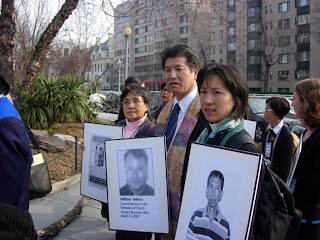
Rev. Vertucio presented research she conducted with the ordained women ministers in the UCCP Southern Luzon Jurisdiction Area. Her study found that although women are conferred the status of ordination in the UCCP, (the first woman was ordained pastor in 1936, and bishop in 1998), women are in the vast minority and do not have a fair representation or equal status in the church leadership, especially at regional and national church levels. Many women church workers in the Philippines tend to be steered towards being Deaconesses rather than ordained as clergy who exert more authority in the decision-making and executive functions of the church.

The historical ordination of a few women, has failed to address the issue of women's subordination and the inclusion of a women's agenda (the valuing of women's lives and natural gifts) in church ministry. Vertucio mentioned a myriad of structural, cultural and social obstacles facing women pastors and warned that the church must be careful not to be content with the mere ordination of women. Such contentment, she warned, leaves the plight of women still unattended. True change will only be addressed when ministry is redefined as partnership among women and men. The UCCP as a church is committed to the transformation of society and involved in the struggles for democracy and justice in the Philippines. Vertucio commented that these movements have often asked women to put the "women's issue" on the back burner. But true liberation, she said, cannot happen unless it also includes justice, liberation and equality for women.

Rev. Vertucio hopes to create a program of empowerment that will address the isolation and marginalization of Filipino women pastors.

Wednesday, March 21, 2007

Spiritual Reflections on the March 14, 2007 Senate Hearing on the Extra-Judicial Killings in the Philippines

Washington D.C.

The feeling was euphoric, almost elation. The hearing had come to a close- there was almost a collective exhale- a sigh and gasp of joy. As the crowd began to breath and chatter to break the silence, smiles broke out. Claps on the back, sighs of relief. "I started to cry during the hearing," said one friend, then another. “Me too,” I echoed, and we had to pause as the emotion of that moment was still powerfully present.

Something holy happened there in that moment. Tears are the language of God praying, they say. God’s prayers. Signs of holy presence. Hearings happen all the time; they are part of the bureaucratic political structure. It’s hard to measure exactly what will come out of it, or how immediately we will see any results in terms of an end to the political assassinations and accountability of the Armed Forces of the Philippines and U.S. military. There is much more follow up work to be done. We cannot yet say what the impact of it all is. But we can say that something holy happened there.

Rev. Mike Yoshii (who also attended this hearing) once mentioned at a retreat that his experience of the Congressional Hearings on Redress for Japanese Americans interned in WWII hearing was a pivotal spiritual experience for him. I think maybe I caught a glimpse of that. We always say that the spiritual is political, the political is spiritual. But still I didn’t expect a Senate hearing in the Nation’s Capitol with people dressed in suits and ties to be an experience of divine connection.

So what were those tears about? Perhaps they were tears of being heard. Not just by anyone - but tears that truth had been spoken and heard by the mighty and powerful. That somehow some "light had shined on the truth," as Senator Boxer said, as she commended the witnesses from the Philippines for doing the hard job of truth-telling when truth-telling can cost you your life.

Tears that some accountability was being administered. Hard questions were being asked of a State Department that dances around and hides, speaking in euphemisms about the U.S. war machine and the false democracy of our allies. Tears that the lies were being exposed. Tears that the story of the seven poor farmers massacred at dawn while working in their rice fields would be told here in the halls of the most powerful country in the world. That the senseless taking of their lives and the livelihoods of their surviving families would be lifted up at the same table where the State Department representative spun his web of half-truths. Life and truth would be spoken here. Just this act was so powerful.

Perhaps the tears were for of all those stories and individual lives lost and affected. We had heard testimony after testimony, report after report for a full day in the conference prior, yet somehow, the lives and spirits of the hundreds and their thousands of kin seeking justice filled the hall that day. Our tears were also for the delegation from the Philippines who have become our friends – and our fear and love as we say goodbye to them and they return to unknown conditions in the Philippines- where their protection is not guaranteed.

Towards the end of the hearing, Senator Boxer asked the witnesses testifying on the reality of the extrajudicial killings if they could ever recall a time in the past, a particular case, when the Philippine’s government was held accountable for its actions. First Marie from KARAPATAN, in her fragile voice, shook her head and said “No.” Followed by “No”, “No”, No” down the panel. Little more needed to be said.

A friend in attendance at the hearing, an immigrant from the Philippines said, “This is how the system is supposed to work," referring to the democratic process we had just witnessed. I am an ABC (American Born Chinese) so I take a lot of this for granted. I vote, but I am also more used to being on the outside of the political process – or at least the outside of the government buildings with signs, protesting and chanting. Maybe I thought that was where I felt most comfortable - because of my race, gender, political beliefs. I suppose that is where I assumed I would see and experience God- on the outside, not on the inside, engaging in the political process.

I have always been a critic of our so-called U.S. democracy that is so over-run by big-money and big business, cynical in thinking that all those letters and petitions that I sign do not really make a difference and that politicians don’t really care. Democracy and accountability in this country is a far cry from ideal, and even feels like a crapshoot sometimes, but it has been a powerful experience to see it at work, to see that it is possible, that we could have some access and recognition by our government leaders, and that justice did stand a chance.

There was something about that hearing process that reminded me of the New Testament story in Luke 5:17-21, the healing of the paralytic. Jesus is teaching and healing in a house, and a large crowd has gather, including the Pharisees and doctors of the Law who had come from every village in Galilee, from Judaea and Jerusalem. These were the powers-that-be, the top officials, the government leaders. A man who was paralyzed wanted to go to Jesus, to get close- perhaps he wanted to hear the teachings, to be healed, to be seen and touched by Jesus. But because of the crowds it was impossible. So with the help of his friends carrying him on his bed, they climb up on the roof and make a hole in the tiles and lower him down into the middle of the gathering in front of Jesus. Jesus is moved by their faith and the man is healed.

That’s a little of what it was like. There seemed to be no way to get in, to be heard by the powerful and mighty. So many issues and concerns, so many officials crowding the space and the airtime. Somehow we found a way to get into the halls of Congress. Like the healing story, it requires many, many hands and even unconventional measures. But as friends we will find a way to create a place inside. Just the getting there is holy in itself. Even if nothing more happened. But Jesus recognizes that faith, the man is recognized for what he is, not a paralytic, but as one who is faithful. How powerful, spiritually it is to be “recognized,” to be truly seen and known and understood- to be taken as one who can give witness and testament to the truth. How touching and healing it is for one to say, “Yes, of course, I see your pain and your suffering and your great faith. I recognize what is going on here. Come, welcome here into this place.” That happened in that hearing. When Senator Boxer understood what was being done in the Philippines, she said- “We don’t want another El Salvador here…we don’t want blood on our hands.”

To be heard and recognized by my government is part of that healing and holy moment. Isn’t that what our friends in the Philippines are asking of their government as well? That their cry for justice and the sanctity and worth of all people’s lives be recognized, that the ongoing economic and political suffering of the people be seen, acknowledged and truly addressed.

The hearing took place on the last day of the conference which was called, “A day of truth, reckoning and hope.” Indeed it was.

-Rev. Deborah Lee

March 14, 2007: Philippines Human Rights Senate Hearing. Reportback and video link.

I just returned from Washington D.C. where I attended the International Ecumenical Conference on Human Rights in the Philippines and the Senate Hearing on Extrajudicial Killings in the Philippines. Many of you have attended some of our educational forums on this subject, received our emails, helped us to write letters, publicized and spread the word. Thank you! It has been such an exciting time since PANA has gotten involved with this issue at the Human Rights Day “ People’s Worship” or “Pagsambang Bayan” in Daly City on Dec. 10, 2006. Little did we realize that there was a powerful convergence of forces and Spirit about to take place. Bishop Eli Pascua and Rev. Tess Vertucio from the United Church of Christ Philippines spent one month in Northern California speaking at numerous venues about the issue; 17 members of the United Methodist Cal-Nevada conference were sent on a fact-finding trip to the Philippines in mid-February; during this trip, the U.N. Rapporteur, Philip Alston, issued his report on the Extra-judicial killings implicating the military, and then the Philippine's government finally released the conclusions of their own Melo Commission report which also pointed to the military as responsible for the killings.

In February, we began a flurry of legislative visits in Northern California with the strong participation of several Filipino-American pastors and community leaders; Our target had been Senator Boxer with the request of an official on-the-congressional-record Senate hearing in her new post as chair of the Asia Pacific subcommitee of the International Relations Committee. We had wanted this hearing to be March 12-14 when the delegation of religious and NGO leaders from the Philippines would be in DC to offer firsthand testimony. It was a bold request on a tight deadline and so we were not totally surprised despite our flurry of efforts when her office said “No.” But the activity did not cease, and on Thursday, March 8, 2007, just 4 days before the beginning of the Philippine’s Human Rights conference they changed their mind and said “Yes!” All those letters, the newspaper articles, the hundred of people with whom Bishop Pascua and Rev. Vertucio talked and met all over Northern California and Nevada, a significant letter by Rev. Bob Edgars, Pres. of the National Council of Churches, the work of many staff and lawyers working in the ecumenical denominational offices and D.C. law offices lobbying the aides and staffers- all put together worked! All of these activities and voices across the country and internationally converged. Every connection counted! I can remember a form letter to Barbara Boxer signed by a PSR alum who attended one of the educational forums. He wrote at the bottom in his own handwriting: "I met you at a wedding I officiated, please look into this serious matter."

So the official Hearing on Extrajudicial Killings in the Philippines was “ON” for March 14th- a victory in itself. But that was just the beginning of a dramatic few days leading up to the hearing. Within a span of less then a week, the Philippine government raided the home and sought to arrest leftist Philippine Senator Satur Ocampo as part of their political crackdown. He in turn announced that he was on his way to travel to D.C. to testify at the Hearing creating quite a stir. It was not really true, but a tactic to seek protection for himself- and it in turn put a lot of attention on the Hearings. Then, a day later, the Philippine's government and newspaper headlines read that the top two Military Generals and two Chief of Police were on their way to Washington D.C. to attend the hearings to “observe” and clarify "truth from propaganda." This audacity of the Philippine government significantly raised the tension and level of concern for the Philippine delegates at the conference, particularly, because during the span of the 3 day conference, 2 more activists were killed in the Philippines.

Fortunately, Senator Boxer’s office made it clear that there would be no intimidation or fear at the hearing and that Philippine Military and Police were not allowed to be at the hearing. (Whew!) Instead, the Philippine embassy attended and submitted a written report to represent the government’s views- a much more appropriate diplomatic response than sending the military!

During the hearing itself- Senator Boxer was brilliant and tenacious in challenging the State Department’s claims that the Philippines was a vibrant democracy, taking adequate measure to address the killings, painting a rosy picture of the situation. The others who testified were T. Kumar from Amnesty International, G. Eugene Martin from the Philippine Facilitation Project/U.S. Peace Institute, Bishop Eliezer Pascua from the United Church of Christ Philippines and Marie Hilao-Enriquez from KARAPATAN, a human rights group in the Philippines.

You can see the live footage of the hearing at the following link: http://foreign.senate.gov/hearings/2007/hrg070314p.html. (You may need to skip ahead 20 minutes for the actual start of the hearing.)
-Rev. Deborah Lee

Tuesday, March 20, 2007

March 24 guided visit to Masjid Al-Noor in Santa Clara

Today is the last day to register for our March 24 guided visit to Masjid Al-Noor in Santa Clara, the largest mosque in California. We will learn about Muslim religious life, as well as social issues that concern Muslim Americans. In particular, we will discuss the effects of domestic terrorism directed at Muslims in the wake of 9/11.

Coordinated by Jaideep Singh, Visiting Scholar-in-Residence for the PANA Institute's Civil Liberty and Faith Project, and instructor of PSR course RSHR-1070: "Presumed Guilty: Race, Religion, and the Post-9/11 Racialized State"

Contact pana@psr.edu, 510-849-8244, to register.

Monday, March 19, 2007

March 7: Rev. Teresita B. Vertucio, United Church of Christ Philippines

You are invited to an International Women's Day Luncheon:

Join us at PANA for a lunch, presentation and discussion

Wednesday, March 7th

12:00 noon

Please RSVP

International Speaker:

Rev. Teresita B. Vertucio,

elected Conference Minister (Pastoral/Executive Position) of the

United Church of Christ Philippines

Northeast Southern Tagalog Conference

“Leaders yet Subordinate: The Place of Women Ministers in the Church”

This paper draws from Rev. Teresita B. Vertucio’s experience and research of the UCCP South Luzon Jurisdiction Area where women are ordained yet hardly stand on equal footing with male counterparts in terms of policy making and program initiatives of the church. The very low percentage of women who are having access to empowerment programs, and being yet unorganized, contribute to this status of subordination in a church that is patriarchal.

REV. TERESITA B. VERTUCIO was ordained minister of the United Church of Christ in the Philippines in 1987 after already serving as a Lay Pastor since 1980. She has a Bachelor of Theology from Union Theological Seminary Philippines (1978-1982), and Master of Arts in Religious Studies--Women & Religion (Thesis Writing) from 2002-2004. She had some involvement in GABRIELA Southern Tagalog (early 90's) and DIAKONIA, a women church workers’ organization (also in Southern Tagalog), which has both national and ecumenical character.

Please RSVP for the luncheon: contact Deborah Lee at dlee@psr.edu or 510-829-8260.