i wrote this on the bus,
on the our return home.
-- Michael Sepidoza Campos
...
Circles.
And more circles.
Words woven among stories.
Anger. Despair. Doubt. Hope.
How does one foster life
In a place of desolation?
In the context of paranoia?
I think of Marjorie.
I think of the many prayers.
Silences offered. Quiet tears shed.
Attempts to hide years of feelings.
Shame still persists.
Shame of what?
Vulnerability. Weakness.
Stoicism in the face of dehumanization.
Stoicism as a response to shame.
I will be as a rock, unmoved.
Even as I am stripped.
Even as I am shamed.
I think of the gardens.
Fruits of one's anger. Spaces of defiance.
Dispelling the paralysis of fate.
Stoicism bearing life.
Where one chooses not to be unmoved.
Where one effects life upon land.
Upon barrenness. Lifelessness.
How does one breathe
While suffocating beneath fear?
How does one see
Beyond the veil of dust storms?
How does one hear
Bereft of community?
Families that foster love?
How does one live?
But life persists. Is relentless.
Where terrain, though desolate
Channel a people's spirit to hope deeply.
To see beneath the veneer of discomfort.
To claim life upon a land that has both
Spat and embraced them.
There is stunning hope here.
There is gratitude from which I draw life.
I the foreigner. The stranger.
Encounter the voices of our common ancestors.
And I learn to see with their eyes.
Hear with their ears.
And so hope as deeply.
I am grateful.
I stand in paths of circles.
Enveloped by voices of intersecting stories.
And so, I am ennobled by a humanity
That stands fundamentally the same,
A common grounding upon life.
Of circles. Of cyclical immersions
In life and death.
Between hope and despair.
Circles. Circles. Circles.
--
Michael Sepidoza Campos
Interdisciplinary Studies
Graduate Theological Union
Berkeley, CA
---
Read more reflections by the pilgrimage participants.
Sunday, June 24, 2007


Monday, June 4, 2007
Podcast: Manzanar reflections by seminarian Shelley Page
Podcast of Starr King student Shelley Page as she reads the poems she wrote in response to her pilgrimage to Manzanar, a California relocation camp where the U.S. government held 10,000 persons of Japanese ancestry for three years during World War II.
Read more reflections by the pilgrimage participants.
Read more reflections by the pilgrimage participants.
Tuesday, May 29, 2007
Asian Faith Leaders To Speak Out in Support of Lesbian and Gay Families and Equality
PRESS CONFERENCE:
ASIAN FAITH LEADERS TO SPEAK OUT IN SUPPORT OF
LESBIAN AND GAY FAMILIES AND EQUALITY
Announcement of Support is a Historic First
SAN FRANCISCO, THURSDAY, MAY 31, 2007 - Several prominent Asian American faithleaders in the Bay Area will announce their public support of lesbian and gay families and equality at a press conference in San Francisco Chinatown onThursday, May 31, 2007, from 10:30-11:30 am, at Chinese for Affirmative Action(17 Walter Lum Place, nearby Portsmouth Square), to coincide with end of APIHeritage Month and the start of LGBT Pride Month.
Confirmed speakers for theevent include: Rev. Calvin Chinn, Rev. Jeffrey Kuan, Rev. John Oda, Rev. DeborahLee, Rev. Michael Yoshii, and Rev. Elizabeth Leung. The event will mark the first time a coalition of Asian American faith leaders speaks out in support oflesbian and gay families and equality.
Photos of the press conference by Andy Wong.
Tuesday, May 22, 2007
R2W Summer Youth Leadership Institute - Now Accepting Applications! Priority Deadline May 30th!

imagine us
Represent 2 Witness Summer Youth Leadership Institute
for Asian Pacific Islanders and other youth of color ages 16-19
lower income and LGBT persons encouraged to apply
June 23 - July 7, 2007
Pacific School of Religion
Berkeley, CA
IMAGINE US
DOING
theology (the study and action of God in the world)
dynamic Bible study martial arts community action
MEETING WITH
poets professors community leaders DJs muralists
DEVELOPING LEADERSHIP
through a soul-stretching process called critical faith
CELEBRATING AND WORSHIPPING WITH
young leaders age 16-19
of Asian, Pacific Islander, African American, Latino, and other ethnic background
IMAGINE US
creating a just and blessed future
being the future
the future is
now
Get your discipleship on
R2W is an institute in which you live, study, and celebrate living the collegiate lifestyle for 14 days with other high school-aged students in the beautiful Pacific School of Religion/UC Berkeley community. R2W uses the Asian Pacific Islander experience as a lense to see and act on problems and solutions as new Christian leaders. Participants receive a full scholarship covering transportation to and from Berkeley, room, board, and activities. Enrollees pay a registration fee of $150. We encourage your church to support you by covering this fee. (A fee waiver is available to all with financial hardship.)
See what's up at: www.represent2witness.org and www.myspace.com/represent2witness
or contact Michael, Lauren, or Crystal at mjames@psr.edu or (510) 849-8202
Priority application deadline May 30, 2007
Represent 2 Witness Summer Youth Leadership Institute
for Asian Pacific Islanders and other youth of color ages 16-19
lower income and LGBT persons encouraged to apply
June 23 - July 7, 2007
Pacific School of Religion
Berkeley, CA
IMAGINE US
DOING
theology (the study and action of God in the world)
dynamic Bible study martial arts community action
MEETING WITH
poets professors community leaders DJs muralists
DEVELOPING LEADERSHIP
through a soul-stretching process called critical faith
CELEBRATING AND WORSHIPPING WITH
young leaders age 16-19
of Asian, Pacific Islander, African American, Latino, and other ethnic background
IMAGINE US
creating a just and blessed future
being the future
the future is
now
Get your discipleship on
R2W is an institute in which you live, study, and celebrate living the collegiate lifestyle for 14 days with other high school-aged students in the beautiful Pacific School of Religion/UC Berkeley community. R2W uses the Asian Pacific Islander experience as a lense to see and act on problems and solutions as new Christian leaders. Participants receive a full scholarship covering transportation to and from Berkeley, room, board, and activities. Enrollees pay a registration fee of $150. We encourage your church to support you by covering this fee. (A fee waiver is available to all with financial hardship.)
See what's up at: www.represent2witness.org and www.myspace.com/represent2witness
or contact Michael, Lauren, or Crystal at mjames@psr.edu or (510) 849-8202
Priority application deadline May 30, 2007
Friday, May 11, 2007
Reflections from the 2007 PANA Pilgrimage to Manzanar
On the eastern side of the Sierras of California, Mt. Williamson, the second highest peak after Mt. Whitney on the continental United States, is the summit that stands tall behind the cemetery obelisk of Manzanar, the war relocation center of World War II, where 10,000 people of Japanese descent were displaced from Los Angeles. From April 26-29, 2007, on the annual pilgrimage to Manzanar, our community pilgrimage class, co-sponsored by the Pacific School of Religion and the PANA Institute, joined with over 700 other pilgrims who were from a diversity of cultural and religious backgrounds. There, in the hot desert sun by the cemetery obelisk with its inscription “This is the place of consolation for all humanity,” we gathered to remember, to mourn, to listen, to pray, to dance with hope and gratitude for the imprints of compassion on our hearts. We literally encountered imprints of hope in the stone and waterfall gardens created by the internees for the contemplation of restorative beauty amidst the unjust desert incarceration - the unfailing stream of integrity, the flowing waters towards justice. Imprints of hope: Birdsong on barbed wire. Dawn and dusk at Manzanar, communion with the living and the dead. Echoes of children’s voices, both past and present. Youth reaching out across the barbed wire realities of today. Elders and ancestors passing on wisdom and strength for the journey.


Community Poem written by 2007 PANA Pilgrims to Manzanar 4/29/07
Empty desert, intense sun, lonely stars, snowy mountains.
Silence.
Racist bullies calling us names, Dirty Japs they yell, assaulting immigrants.
Nanay.
Betrayed, Disrespected, We live in cold fear, Shamed by acts of injustice.
Silence.
Sorrowful eyes climbing onto departing buses, arriving at foreign barracks.
Silence.
Not understanding a child. A baby left behind, a baby’s grave...
The loss of loved ones.
Silence.
Huge lands, unrelenting Desolation.
Consolation
Prayer flags.
Chikara. Love. Family.
Stories.
Black crow on obelisk.
Forgive.
Remembrance.
Interpretive Center.
Gardens and pond.
Reclaim
Revolt
Remain
Re-emergence
Remembrance.
Supportive community.
Interfaith ceremony
Together in pain.
Obelisk
Small resistance
Adaptation.
Reparation.
Remembrance.
Taiko drums
Young voices
Living
Quakers
Singing a hymn with Toru
Singing freely in Japanese.
Remembrance.
Satisfaction.
Remembrance.
巡礼の詩 (Junrei no uta) 4/29/07
何もない砂漠、厳しい日差し、寂しい星空、雪を頂く山々。
沈黙。
差別者たちは我々を罵り、「汚いジャップ」と叫び、移民を攻撃する。
ナナイ(母よ)。
裏切られ、見下され、我らは凍てつく怖れに生きる、不正な行いによる辱めを受けながら。
沈黙。
悲しみの眼をもって旅立つバスに乗り込み、見慣れないバラックに降り立つ。
沈黙。
子どもたちへの思いやりはなく、置き去りにされた赤ん坊もいる、その子の墓はそこに残された…。
沈黙。
愛する人々は亡くなった。
沈黙
広大なる大地、過酷なる荒廃。
慰めは、
祈りの旗。
力。愛。家族。
物語。
慰霊塔にとまるカラス。
赦し。
忘れないこと。
学習センター。
庭と池。
再生。
抵抗。
消え去らないこと。
また姿を現すこと。
忘れないこと。
共同体の助け。
様々な宗教による慰霊祭。
共に痛みを覚えること。
慰霊塔。
暴力による反抗は小さかったこと。
社会復帰。
補償。
忘れないこと。
太鼓の響き。
若い声。
躍動。
クエーカーたちの助け。
トオルさんと共に賛美歌を歌えること。
日本語で伸び伸びと歌を歌えること。
忘れないこと。
贖罪。
忘れないこと。
*********
KIZUNA
by Tomo Nishiyama, translated by Tomo Nishiyama
We have many expression of Love.
We have many expression of Hope.
We have many expression of faith.
These are important things in our life.
We keep expressing.
Now, let us focus on anther thing.
We are here, now.
We are here beyond race, language, country, origin, and religion…
We are share time and place.
It is truth. Nobody question it.
There is a special relationship in here.
We call it “ KIZUNA”
Let’s just feel “KIZUNA”
We don’t need special pray, chant, action…
Just feel “KIZUNA”.
“絆”(KIZUNA)
たくさんの愛がある (takusan no ai ga aru)
たくさんの希望がある (takusan no kibou ga aru)
たくさんの信じることがある (takusan no shinzirukoto ga aru)
そのすべては私たちにとって大切なこと
(sonosubete ha watassitatinitotte taisetunakoto)
そして続いていくこと (sosite tuduitteikukoto)
そして今、もう一つのことに目を向けてみよう
(sosite ima mouhitotunokotoni mewo muketemiyou)
今、ここにいること(ima kokoni irukoto)
人種、言葉、国、宗教、祖先の違いを超えて、私たちはここにいる
(zinsyu kotoba kuni syuukyou sosen no tigaiwokoete watasitatiha kokoni iru)
時間と空間をともにしている(zikan to kuukan wo tomonisiteiru)
それは誰も疑えないこと(soreha daremo utagaenaikoto)
特別なつながりがここにはある(tokubetuna tunagari ga kokoniha aru)
それを“絆”と呼ぼう( sorewo KIZUNA to yobou)
“絆”ただそれを感じよう (KIZUNA tada sorewo kanziyou)
特別な祈りやことばはいらない (tokubetuna inori ya kotoba ha iranai)
ただ感じる(tada kannziru)
ただ此処にいる(tada kokoniiru)
*******
By Maikiko James
Remember always
A life in a storm of dust
Four years of gray
and, if you listen closely,
Subtle whispers of laughter
I went back to be reminded
And instead found what I did not expect
Painful hope
And proof that we rise stronger
From the ash
Bonded in this one life we are given
We sustain from our place
in the palms of our ancestors
Carried through the day
By kizuna
May we find more each moment
We remember
*****
By Lauren Quock
Day 1
Motivation:
Method
Everyone has a story
We can teach from our stories
We can learn from each others' stories
We are all teachers and students
We don't need to have degrees to have knowledge
Some people go up to a mountain
far away from civilization
to find the sacred
Others go into the community
to find the sacred
among the people
Once I got to the class
I knew I had to come on the pilgrimage
for the content
Anti-Asian hate
written into law
silence from fear
that would last generations
What do I bring?
Sketchbook and pencil
film and 2 cameras
To document
Write ourselves into the textbooks
where they left us out
Mark by mural my witness
that we are active participants in history
My grandparents --
we are standing
on the shoulders
of giants
On the six hour bus ride
We pass by a state prison
In the middle of empty rolling hills
Rows of farm crops
A Wal-mart
They are still incarcerating us
Shipping us out
into the middle of nowhere
So no one has to see us
They are still separating us
from our families
Stripping us of our freedom and privacy
from guard towers
guns pointed inward
Barbed wire cuts us offfrom the rest of the world
Day 2
I laid my hand
on your grave
Cesar Estrada Chavez
1922-1993
images of sweat beading and dripping
from brown foreheads
hands in fertile soil
picking fruit you can't afford to buy
espaldas sore from crouching
and bending all day
I feel your strength in the rock
I will keep on
fighting
believing
Si se puede!
Yes we can.
Signs of resistance
Pleasure gardens
in the middle of the desert camp
No tears
Resistance
Day 3
Today
The tears came
Three remaining living members of the 442nd
rose to lead the pledge of allegiance
Red White and Blue sailor's hat
War patches
In the midst of the camps
These men volunteered to fight for their country
The country that was interning them!
To prove their loyalty
Todaythe tears came
they were so loyal
I think I would have spit in the faces of the recruiters
shouted an angry "Fuck you!"
But they volunteered
They were sent to Italy
to take a position that nobody else had been able to
Landed in the middle of the night
Ordered to scale a cliff
"If you fall"
they were told
"Don't cry out
It will give away our position"
And some of them fell
And they did not cry out
And the 442nd took the cliff
Today
the tears came
A headstone in the cemetery
Baby Jerry Ogawa
How painful the memory must have been
For your family to leave you
A dusty piece of broken porcelain
a plate
a rusty tin can
barbed wire wrapped up and tossed aside
I feel your spirits here
You were here
How could they do this to you?
Today
the tears came
Today
we came
To visit the graves
To remember the dead
and the living
Today
the tears came
Return
It's been 10 days since I got back
little time to reflect
since then
so now
before the memory fades
before my hope dissipates:
Running free
on land
with barbed wire boundaries
real not remembered
but 60 years ago
Singing
Dancing
Playing the guitar
saxophone
freely
expressing rage
sadness
survival
life
'til all hours of the night
no searchlights
from guard towers
roaming
Toru says he's not a Christian anymore
But if he can forgive
And hope
And live
singing
serenading
So can I.
*******
*******
Article in the Sacramento Bee that included a picture of our prayer flags!:
http://www.sacbee.com/history/story/172579.html
*******
Podcast of Starr King student Shelley Page as she reads the poems she wrote in response to her pilgrimage to Manzanar.
*******
i wrote this on the bus,
on the our return home.
-- Michael Sepidoza Campos
Interdisciplinary Studies
Graduate Theological Union
Berkeley, CA
...
Circles.
And more circles.
Words woven among stories.
Anger. Despair. Doubt. Hope.
How does one foster life
In a place of desolation?
In the context of paranoia?
I think of Marjorie.
I think of the many prayers.
Silences offered. Quiet tears shed.
Attempts to hide years of feelings.
Shame still persists.
Shame of what?
Vulnerability. Weakness.
Stoicism in the face of dehumanization.
Stoicism as a response to shame.
I will be as a rock, unmoved.
Even as I am stripped.
Even as I am shamed.
I think of the gardens.
Fruits of one's anger. Spaces of defiance.
Dispelling the paralysis of fate.
Stoicism bearing life.
Where one chooses not to be unmoved.
Where one effects life upon land.
Upon barrenness. Lifelessness.
How does one breathe
While suffocating beneath fear?
How does one see
Beyond the veil of dust storms?
How does one hear
Bereft of community?
Families that foster love?
How does one live?
But life persists. Is relentless.
Where terrain, though desolate
Channel a people's spirit to hope deeply.
To see beneath the veneer of discomfort.
To claim life upon a land that has both
Spat and embraced them.
There is stunning hope here.
There is gratitude from which I draw life.
I the foreigner. The stranger.
Encounter the voices of our common ancestors.
And I learn to see with their eyes.
Hear with their ears.
And so hope as deeply.
I am grateful.
I stand in paths of circles.
Enveloped by voices of intersecting stories.
And so, I am ennobled by a humanity
That stands fundamentally the same,
A common grounding upon life.
Of circles. Of cyclical immersions
In life and death.
Between hope and despair.
Circles. Circles. Circles.
--
Community Poem written by 2007 PANA Pilgrims to Manzanar 4/29/07
Empty desert, intense sun, lonely stars, snowy mountains.
Silence.
Racist bullies calling us names, Dirty Japs they yell, assaulting immigrants.
Nanay.
Betrayed, Disrespected, We live in cold fear, Shamed by acts of injustice.
Silence.
Sorrowful eyes climbing onto departing buses, arriving at foreign barracks.
Silence.
Not understanding a child. A baby left behind, a baby’s grave...
The loss of loved ones.
Silence.
Huge lands, unrelenting Desolation.
Consolation
Prayer flags.
Chikara. Love. Family.
Stories.
Black crow on obelisk.
Forgive.
Remembrance.
Interpretive Center.
Gardens and pond.
Reclaim
Revolt
Remain
Re-emergence
Remembrance.
Supportive community.
Interfaith ceremony
Together in pain.
Obelisk
Small resistance
Adaptation.
Reparation.
Remembrance.
Taiko drums
Young voices
Living
Quakers
Singing a hymn with Toru
Singing freely in Japanese.
Remembrance.
Satisfaction.
Remembrance.
巡礼の詩 (Junrei no uta) 4/29/07
何もない砂漠、厳しい日差し、寂しい星空、雪を頂く山々。
沈黙。
差別者たちは我々を罵り、「汚いジャップ」と叫び、移民を攻撃する。
ナナイ(母よ)。
裏切られ、見下され、我らは凍てつく怖れに生きる、不正な行いによる辱めを受けながら。
沈黙。
悲しみの眼をもって旅立つバスに乗り込み、見慣れないバラックに降り立つ。
沈黙。
子どもたちへの思いやりはなく、置き去りにされた赤ん坊もいる、その子の墓はそこに残された…。
沈黙。
愛する人々は亡くなった。
沈黙
広大なる大地、過酷なる荒廃。
慰めは、
祈りの旗。
力。愛。家族。
物語。
慰霊塔にとまるカラス。
赦し。
忘れないこと。
学習センター。
庭と池。
再生。
抵抗。
消え去らないこと。
また姿を現すこと。
忘れないこと。
共同体の助け。
様々な宗教による慰霊祭。
共に痛みを覚えること。
慰霊塔。
暴力による反抗は小さかったこと。
社会復帰。
補償。
忘れないこと。
太鼓の響き。
若い声。
躍動。
クエーカーたちの助け。
トオルさんと共に賛美歌を歌えること。
日本語で伸び伸びと歌を歌えること。
忘れないこと。
贖罪。
忘れないこと。
*********
KIZUNA
by Tomo Nishiyama, translated by Tomo Nishiyama
We have many expression of Love.
We have many expression of Hope.
We have many expression of faith.
These are important things in our life.
We keep expressing.
Now, let us focus on anther thing.
We are here, now.
We are here beyond race, language, country, origin, and religion…
We are share time and place.
It is truth. Nobody question it.
There is a special relationship in here.
We call it “ KIZUNA”
Let’s just feel “KIZUNA”
We don’t need special pray, chant, action…
Just feel “KIZUNA”.
“絆”(KIZUNA)
たくさんの愛がある (takusan no ai ga aru)
たくさんの希望がある (takusan no kibou ga aru)
たくさんの信じることがある (takusan no shinzirukoto ga aru)
そのすべては私たちにとって大切なこと
(sonosubete ha watassitatinitotte taisetunakoto)
そして続いていくこと (sosite tuduitteikukoto)
そして今、もう一つのことに目を向けてみよう
(sosite ima mouhitotunokotoni mewo muketemiyou)
今、ここにいること(ima kokoni irukoto)
人種、言葉、国、宗教、祖先の違いを超えて、私たちはここにいる
(zinsyu kotoba kuni syuukyou sosen no tigaiwokoete watasitatiha kokoni iru)
時間と空間をともにしている(zikan to kuukan wo tomonisiteiru)
それは誰も疑えないこと(soreha daremo utagaenaikoto)
特別なつながりがここにはある(tokubetuna tunagari ga kokoniha aru)
それを“絆”と呼ぼう( sorewo KIZUNA to yobou)
“絆”ただそれを感じよう (KIZUNA tada sorewo kanziyou)
特別な祈りやことばはいらない (tokubetuna inori ya kotoba ha iranai)
ただ感じる(tada kannziru)
ただ此処にいる(tada kokoniiru)
*******
By Maikiko James
Remember always
A life in a storm of dust
Four years of gray
and, if you listen closely,
Subtle whispers of laughter
I went back to be reminded
And instead found what I did not expect
Painful hope
And proof that we rise stronger
From the ash
Bonded in this one life we are given
We sustain from our place
in the palms of our ancestors
Carried through the day
By kizuna
May we find more each moment
We remember
*****
By Lauren Quock
Day 1
Motivation:
Method
Everyone has a story
We can teach from our stories
We can learn from each others' stories
We are all teachers and students
We don't need to have degrees to have knowledge
Some people go up to a mountain
far away from civilization
to find the sacred
Others go into the community
to find the sacred
among the people
Once I got to the class
I knew I had to come on the pilgrimage
for the content
Anti-Asian hate
written into law
silence from fear
that would last generations
What do I bring?
Sketchbook and pencil
film and 2 cameras
To document
Write ourselves into the textbooks
where they left us out
Mark by mural my witness
that we are active participants in history
My grandparents --
we are standing
on the shoulders
of giants
On the six hour bus ride
We pass by a state prison
In the middle of empty rolling hills
Rows of farm crops
A Wal-mart
They are still incarcerating us
Shipping us out
into the middle of nowhere
So no one has to see us
They are still separating us
from our families
Stripping us of our freedom and privacy
from guard towers
guns pointed inward
Barbed wire cuts us offfrom the rest of the world
Day 2
I laid my hand
on your grave
Cesar Estrada Chavez
1922-1993
images of sweat beading and dripping
from brown foreheads
hands in fertile soil
picking fruit you can't afford to buy
espaldas sore from crouching
and bending all day
I feel your strength in the rock
I will keep on
fighting
believing
Si se puede!
Yes we can.
Signs of resistance
Pleasure gardens
in the middle of the desert camp
No tears
Resistance
Day 3
Today
The tears came
Three remaining living members of the 442nd
rose to lead the pledge of allegiance
Red White and Blue sailor's hat
War patches
In the midst of the camps
These men volunteered to fight for their country
The country that was interning them!
To prove their loyalty
Todaythe tears came
they were so loyal
I think I would have spit in the faces of the recruiters
shouted an angry "Fuck you!"
But they volunteered
They were sent to Italy
to take a position that nobody else had been able to
Landed in the middle of the night
Ordered to scale a cliff
"If you fall"
they were told
"Don't cry out
It will give away our position"
And some of them fell
And they did not cry out
And the 442nd took the cliff
Today
the tears came
A headstone in the cemetery
Baby Jerry Ogawa
How painful the memory must have been
For your family to leave you
A dusty piece of broken porcelain
a plate
a rusty tin can
barbed wire wrapped up and tossed aside
I feel your spirits here
You were here
How could they do this to you?
Today
the tears came
Today
we came
To visit the graves
To remember the dead
and the living
Today
the tears came
Return
It's been 10 days since I got back
little time to reflect
since then
so now
before the memory fades
before my hope dissipates:
Running free
on land
with barbed wire boundaries
real not remembered
but 60 years ago
Singing
Dancing
Playing the guitar
saxophone
freely
expressing rage
sadness
survival
life
'til all hours of the night
no searchlights
from guard towers
roaming
Toru says he's not a Christian anymore
But if he can forgive
And hope
And live
singing
serenading
So can I.
*******
*******
Article in the Sacramento Bee that included a picture of our prayer flags!:
http://www.sacbee.com/history/story/172579.html
*******
Podcast of Starr King student Shelley Page as she reads the poems she wrote in response to her pilgrimage to Manzanar.
*******
i wrote this on the bus,
on the our return home.
-- Michael Sepidoza Campos
Interdisciplinary Studies
Graduate Theological Union
Berkeley, CA
...
Circles.
And more circles.
Words woven among stories.
Anger. Despair. Doubt. Hope.
How does one foster life
In a place of desolation?
In the context of paranoia?
I think of Marjorie.
I think of the many prayers.
Silences offered. Quiet tears shed.
Attempts to hide years of feelings.
Shame still persists.
Shame of what?
Vulnerability. Weakness.
Stoicism in the face of dehumanization.
Stoicism as a response to shame.
I will be as a rock, unmoved.
Even as I am stripped.
Even as I am shamed.
I think of the gardens.
Fruits of one's anger. Spaces of defiance.
Dispelling the paralysis of fate.
Stoicism bearing life.
Where one chooses not to be unmoved.
Where one effects life upon land.
Upon barrenness. Lifelessness.
How does one breathe
While suffocating beneath fear?
How does one see
Beyond the veil of dust storms?
How does one hear
Bereft of community?
Families that foster love?
How does one live?
But life persists. Is relentless.
Where terrain, though desolate
Channel a people's spirit to hope deeply.
To see beneath the veneer of discomfort.
To claim life upon a land that has both
Spat and embraced them.
There is stunning hope here.
There is gratitude from which I draw life.
I the foreigner. The stranger.
Encounter the voices of our common ancestors.
And I learn to see with their eyes.
Hear with their ears.
And so hope as deeply.
I am grateful.
I stand in paths of circles.
Enveloped by voices of intersecting stories.
And so, I am ennobled by a humanity
That stands fundamentally the same,
A common grounding upon life.
Of circles. Of cyclical immersions
In life and death.
Between hope and despair.
Circles. Circles. Circles.
--
Monday, May 7, 2007
May 8: Brown Bag with Dr. Gordon Lee
PANA Invites You to a Brown Bag Conversation with
Dr. Gordon Lee:
Understanding Racial Trauma
as a Practice to Discover and Liberate Oneself and Community
Implications for Asians in the Americas
Tuesday, May 8
4:00pm
PANA Offices, 2357 LeConte Ave, Berkeley, CA 94709
Gordon Lee was born and raised in Honolulu, Hawaii. In the fall of 1967 he went to Columbia University to study Economics. He became involved in the Asian-American movement in the spring of 1970 when students at Columbia took over Kent Hall demanding an ethnic studies program. He was active in an uptown Asian American organization fighting for squatters' rights. He was one of the original members of the Asian Media Collective, and soon thereafter moved to New York Chinatown. After leaving New York he joined Third Arm, a community organization in Honolulu, Chinatown and spent many years there assisting residents to fight urban renewal. Subsequently, he became an attorney. In addition to his legal work, he has developed a health insurance counseling and assistance program for seniors. He wrote, directed and produced a video on Japanese internment in Hawaii during World War II. He holds a Masters in Public Health that focused on the Anti-eviction struggle in Oakland, Chinatown. He has recently completed a Ph.D. in depth psychology at Pacifica Graduate Institute in Santa barbara, California. The title of his dissertation is: "Excavating Memory, Reconstructing Narrative: The Nikkei Diaspora and the Transnational Experience from 1868-1941."
Dr. Gordon Lee:
Understanding Racial Trauma
as a Practice to Discover and Liberate Oneself and Community
Implications for Asians in the Americas
Tuesday, May 8
4:00pm
PANA Offices, 2357 LeConte Ave, Berkeley, CA 94709
Gordon Lee was born and raised in Honolulu, Hawaii. In the fall of 1967 he went to Columbia University to study Economics. He became involved in the Asian-American movement in the spring of 1970 when students at Columbia took over Kent Hall demanding an ethnic studies program. He was active in an uptown Asian American organization fighting for squatters' rights. He was one of the original members of the Asian Media Collective, and soon thereafter moved to New York Chinatown. After leaving New York he joined Third Arm, a community organization in Honolulu, Chinatown and spent many years there assisting residents to fight urban renewal. Subsequently, he became an attorney. In addition to his legal work, he has developed a health insurance counseling and assistance program for seniors. He wrote, directed and produced a video on Japanese internment in Hawaii during World War II. He holds a Masters in Public Health that focused on the Anti-eviction struggle in Oakland, Chinatown. He has recently completed a Ph.D. in depth psychology at Pacifica Graduate Institute in Santa barbara, California. The title of his dissertation is: "Excavating Memory, Reconstructing Narrative: The Nikkei Diaspora and the Transnational Experience from 1868-1941."
Friday, April 27, 2007
Apr 24: Vigil for VA Tech - photos, flowers, and prayers

Community Vigil for the Virginia Tech Tragedy
April 24, 2007
Pacific School of Religion, chapel steps
Sponsored by the PANA Institute and the PSR Office of Community Life
 Prayer
Dear Holy One,
We, as ones who have received Your grace and ones who are enabled to call upon you, are before You.
We thank You. Thank You for Your grace to know You and be known by You. Thank you for our new identify as Your children and to be a part of Your reality of community.
We thank You for allowing the community of PANA, with the office of Community of Life at PSR, to have a space for this gathering.
As brothers and sisters, we are here to dedicate our hearts and minds in remembrance of those souls affected by the recent tragedy at Virginia Tech.
Here, we call You to Your presence. Here, we call You for Your guidance and Your comfort, because we are sad, and sorrow for those who are not here any longer and for those who suffered through the loss.
Let our spirits be touched by Yours, for only You can read and know our inner state of hearts and minds.
And only You can create our new space to initiate our comfort and peace and to guide and sustain that condition for our blessings and for Your glory.
Therefore, open Your ears to hear our inner voices and open Your eyes to see our devotions.
We pray that through this time of gathering, You grant us Your strength and comfort so that we can have our peace.
Thank you and pray in the name of Your Son Jesus. Amen
-- prayer led by Kyung-Min Daniel Lee

April 24, 2007
Pacific School of Religion, chapel steps
Sponsored by the PANA Institute and the PSR Office of Community Life
 Prayer
Dear Holy One,
We, as ones who have received Your grace and ones who are enabled to call upon you, are before You.
We thank You. Thank You for Your grace to know You and be known by You. Thank you for our new identify as Your children and to be a part of Your reality of community.
We thank You for allowing the community of PANA, with the office of Community of Life at PSR, to have a space for this gathering.
As brothers and sisters, we are here to dedicate our hearts and minds in remembrance of those souls affected by the recent tragedy at Virginia Tech.
Here, we call You to Your presence. Here, we call You for Your guidance and Your comfort, because we are sad, and sorrow for those who are not here any longer and for those who suffered through the loss.
Let our spirits be touched by Yours, for only You can read and know our inner state of hearts and minds.
And only You can create our new space to initiate our comfort and peace and to guide and sustain that condition for our blessings and for Your glory.
Therefore, open Your ears to hear our inner voices and open Your eyes to see our devotions.
We pray that through this time of gathering, You grant us Your strength and comfort so that we can have our peace.
Thank you and pray in the name of Your Son Jesus. Amen
-- prayer led by Kyung-Min Daniel Lee
About the Centerpiece
 The centerpiece of today’s vigil was designed by PSR student Yi Rang Lim.
 The center collage features those who lost their lives in the tragedy at Virginia Tech.
 Surrounding their images are those of persons who mourn and grieve over the tragedy—while they may have no direct connection to those who perished, they feel connected to them and have been affected by their lives and by their deaths.
Surrounding the images are stones representing our own organic connectedness to the earth.
In many Asian cultures, water symbolizes the cleansing of pain and grief. Symbolically, the tragedy at Virginia Tech rests under the cleansing power of clear water.
Also, in many Asian cultures, white chrysanthemums symbolize grief and mourning—by placing the flowers into the pond, we share in another’s pain.
In addition, there are 33 candles, one for each of those who died in the tragedy.
Today, we encircle these images and symbols as a way of standing in solidarity with those who are in pain, those who mourn, and those who grieve at Virginia Tech and around the globe—we do so knowing that whatever affects one, affects us all.
Related post:
PANA Executive Director Fumitaka Matsuoka's letter about the tragedy.
Thursday, April 26, 2007
Apr 13: R2W's intergenarational event with Samoan Community
April 13, 2007, R2W Staff, Michael James, Lauren Quock and Crystal Talitonu headed out to Calvary United Methodist Church in San Jose to present the R2W Summer Program to Samoan youth and their families from Daly City and San Jose. The evening started off with culture circle introductions by all who were present along with a sentence answer to the following question “What do you think is the biggest struggle facing youth in your community”. It was an intense moment of sharing that was made real through the next phase where we were able to act out “the dramas of our lives” through Popular Theatre. Following a wonderful dinner that was catered by L&L Hawaiian BBQ people got to watch a slideshow from past program attendees as well as statistical facts about the Samoan community. Overall the evening was a blessed event that captured the beauty of the R2W program and the people in the community across generations who maintain hope for the next generation of leaders.
Monday, April 23, 2007
Community Vigil for VA Tech
 Community Vigil
In remembrance of all those affected by the recent tragedy at Virginia Tech
(Please bring a flower)
Tuesday, April 24th, 2007
1:00-1:30pm
Steps of the Chapel at the Pacific School of Religion
1798 Scenic Avenue
Berkeley, CA 94709
Sponsored by the Institute for Leadership Development and Study of Pacific Asian North American Religion (PANA Institute) and the Office of Community Life at the Pacific School of Religion.
For more information, contact Rev. Deborah Lee at
(510)849-8260 or dlee@psr.edu.
Related posts:
- PANA Executive Director Fumitaka Matsuoka's letter about the tragedy.
- Photos and text of prayer and sacred-art offerings at the event.
In God's House accepted at multiple film festivals!
 Since its release in October 2006, In God's House: Asian American Lesbian and Gay Families in the Church has been screened in the Bay Area, Los Angeles, Taiwan, Samoa, and Japan. We have received rave reviews and held captivating discussions for seminary students, API churches and communities, educators, and film festival audiences.
The film has recently been accepted in the Asian Pacific Film Festival in Los Angeles, the Frameline LGBT Film Festival in San Francisco, and the Aomori International LGBT Film Festival in Japan! We have a community screening coming up in Chinatown, San Francisco at the beginning of Pride month and we will be screening the film and conducting workshops at faith-based conferences in Asilomar, CA and Nashville, Tennessee this summer. Check out our screenings page for a screening near you and help us spread the word!
Saturday, April 21, 2007
Notes on Race, Representation, and the Expression of Marginalized Views in the Wake of Virginia Tech
Elaine H. Kim, Professor, Asian American Studies, University of California, Berkeley
I often feel that there is a subterranean current in our society that erupts in moments of crisis, bringing into view some things that are ordinarily hidden. For instance, some Americans, accustomed to images of Denzel Washington as savior of the nation, Will Smith as President of the U.S., and Morgan Freeman as God and to the feeling that they have an African American friend because they watch the Oprah Winfrey Show every afternoon, might have been shocked by the images of real African Americans stranded for days on end after Hurricane Katrina. During crises, a bright spotlight often illuminates dark corners for a brief moment, giving us the chance to see things differently.I would like to open a space for a few additional or alternative viewpoints about the mass killings at Virginia Tech, soon after which I began receiving email messages from Asian American and especially Korean American students and friends. Forgetting for a moment that most people in the U.S. don't differentiate among Asian ethnicities, Chinese and Vietnamese American students admitted that they were relieved to hear that Cho was Korean. Korean American students reported that their parents called them, asking them to come home or telling them not to go out. Were the parents over-reacting? Perhaps they remembered the backlash against South Asians, Arabs, Muslims, and even Latinos who "looked Middle Eastern" in the U.S. after 9-11 or were thinking of what happened to Korean and other Asian shop-keepers in the wake of the L.A. riots. Some of them might have known the internment of Japanese Americans as enemy aliens" during World War II or even about the long history of racial exclusion and violence against Asian immigration and labor.
Many students wrote that when the news first broke, they had imagined the killer as a white male, like Eric Harris and Dylan Klebold of the 1999 Columbine High School massacre in Colorado, Timothy McVeigh of the Oklahoma City bombing that killed 168 people in 1995, Jeffrey Dahmer of Milwaukee, Wisconsin, who murdered and ate 17 boys and men, many of whom were Asian Americans, between 1978 and 1991, and numerous other mass murderers in U.S. history. They knew that news stories never identify white mass murderers or serial killers by race. "I really envy white people," wrote one student, "because when white people do something so brutally and horribly wrong, nobody says,' Do you think it was because he's white?' There are no headlines calling him 'the white shooter.' No one mentions race, because no one thinks his race has anything to do with his crime."
After the Columbine massacre, one television news story after another conjectured to an assumed white middle class viewership about what had made these boys "go wrong." Though angry and alienated like Seung-hui Cho, Harris and Klebold were represented as part of the community, not outside it. In contrast, the Virginia Tech stories invariably described the shooter at first as foreign and later as a lone lunatic. Even though he came to the U.S. at the age of 7 or 8 and spent 2/3 of his life here, attending primary school, middle school, high school, and college in the U.S., Cho was described as Asian, South Korean, Korean, of Korean descent, an immigrant from South Korea, or a Korean "alien resident," Like many other Americans, although he had a green card, he spoke fluent English and was, in fact, much more "American" than "South Korean." One student thought that the news media tried to designate what he did as a "Korean" - as opposed to a crime that was "made in the U.S.A." Another thought that the media stories about the tragedy not only reinforced stereotypes of Asians as "eternal foreigners" rather than as Americans or even as individual human beings but also exploited old racial stereotypes of Asians as inscrutable robotic nerds - cold, robotic, friendless, and weird.
Since the media never let them forget their race and ethnicity, some students remarked that they could not help feeling connected to Seung-hui Cho, even though they if don't want to be. Unpopular as their viewpoint might be, some, without excusing or condoning Cho's actions, did not ascribe to the media portrayals of him as "alien" and "non-human." His face reminded them of friends and relatives.
"I couldn't help but feel like this man deserved…sympathy…. delusional or not, he felt like he was standing up for himself and for others like him, people who were tormented and traumatized for not being able to speak English at first, for the way they look, for being who they are. There's no possible justification for his actions, but it's sad to think about what he must've gone through to finally reach this brink. It's a shame and a pity that there are probably many people who can relate to him because they feel as alone and angry as he did."
Clarity of vision can come in a moment of crisis. In the wake of the Virginia Tech slayings, students wondered how poverty and unfamiliarity with mental health resources might inhibit a family's ability to deal with mental illness. They thought about what would have happened if there had been better gun control and about the insanity of the gun lobby's suggestion that all students be armed. The crisis also exposed the power of the mass media. Of course everyone is horrified and saddened by the murder of innocent people, regardless of race or nationality, several students said, but the South Korean government's condolences are not extended to Iraq, even though more than 200 people were killed and 150 wounded in the four days immediately before and after Virginia Tech. We don't know what those people's faces looked like or what their stories were, not just because they aren't Americans but also because American stories dominate world news 24/7, as Iraqi - and South Korean stories do not. The sudden and massive national attention on a Korean American made them think about how invisible Korean Americans usually are in U.S. national culture.
I am hoping that this crisis will give us all new insights that will stay with us, giving us new courage to express otherwise marginalized views so that we can all participate in dialogues that will strengthen multiracial democracy.
Thursday, April 19, 2007
PANA Letter on VA Tech Tragedy
April 18, 2007
We, the members of the Institute for Leadership Development & the Study of Pacific and Asian North American Religion (PANA Institute) of Pacific School of Religion, are deeply struck by the recent tragedy that took place at Virginia Tech University. We extend our heartfelt condolences to all the people of the university. Our prayers are particularly for the victims, their families, and friends. The horrifying tragedy affects us all like an abrupt rupture of a thread in the web of humanity that sets the whole web trembling.
We at the PANA Institute are also deeply concerned about the fear and anxiety that are fast surfacing in Asian and Oceanic American communities about a possible backlash and retaliation against these communities and their members because of the suspected gunman’s racial and ethnic identity widely reported in the media. Such reporting can subject Asian and Oceanic American communities to unfair portrayals in the current tolerant climate for racial slurs and jokes against people of color.
We at PANA stand with those who are afraid of possible negative repercussions from the tragic incident. We stand with those who may be subjected to all kinds of evil against them because of the racial twist in the reading of the tragedy. We stand with those who hunger and thirst for racial justice. You are not alone. Blessings are particularly yours.
We at PANA appeal to news media of all forms to refrain from referencing and emphasizing the race and ethnicity of the suspected perpetrator of the tragedy. Such an accent does not serve any useful purpose. It only fuels the current climate in this society that demeans people, particularly those who are most vulnerable.
Too many tragic incidents like Virginia Tech have happened in recent years. We at PANA urge faith communities of America to work toward ending violence as a means to settle grievances, may they be personal, communal, or international. It is easy to blame the perpetrators of violence for each of the series of incidents. These individuals and the victims of their violent acts may well be the “canary in the coalmine shaft” of the toxic societal environment in which we all live.
---Fumitaka Matsuoka,
Executive Director, The Institute for Leadership Development & the Study of Pacific and Asian North American Religion, Pacific School of Religion
Related posts:
Response by Professor Elaine Kim
Community Vigil at Pacific School of Religion
We, the members of the Institute for Leadership Development & the Study of Pacific and Asian North American Religion (PANA Institute) of Pacific School of Religion, are deeply struck by the recent tragedy that took place at Virginia Tech University. We extend our heartfelt condolences to all the people of the university. Our prayers are particularly for the victims, their families, and friends. The horrifying tragedy affects us all like an abrupt rupture of a thread in the web of humanity that sets the whole web trembling.
We at the PANA Institute are also deeply concerned about the fear and anxiety that are fast surfacing in Asian and Oceanic American communities about a possible backlash and retaliation against these communities and their members because of the suspected gunman’s racial and ethnic identity widely reported in the media. Such reporting can subject Asian and Oceanic American communities to unfair portrayals in the current tolerant climate for racial slurs and jokes against people of color.
We at PANA stand with those who are afraid of possible negative repercussions from the tragic incident. We stand with those who may be subjected to all kinds of evil against them because of the racial twist in the reading of the tragedy. We stand with those who hunger and thirst for racial justice. You are not alone. Blessings are particularly yours.
We at PANA appeal to news media of all forms to refrain from referencing and emphasizing the race and ethnicity of the suspected perpetrator of the tragedy. Such an accent does not serve any useful purpose. It only fuels the current climate in this society that demeans people, particularly those who are most vulnerable.
Too many tragic incidents like Virginia Tech have happened in recent years. We at PANA urge faith communities of America to work toward ending violence as a means to settle grievances, may they be personal, communal, or international. It is easy to blame the perpetrators of violence for each of the series of incidents. These individuals and the victims of their violent acts may well be the “canary in the coalmine shaft” of the toxic societal environment in which we all live.
---Fumitaka Matsuoka,
Executive Director, The Institute for Leadership Development & the Study of Pacific and Asian North American Religion, Pacific School of Religion
Related posts:
Response by Professor Elaine Kim
Community Vigil at Pacific School of Religion
Thursday, April 12, 2007
KPFA broadcast - Apex Express - Sikh Gurdwara
Wednesday, March 7, 5:30- 8:30 pm
Community Visit: Gurdwara Sahib El Sobrante
Led by Jaideep Singh, Visiting Scholar-in-Residence for the PANA Institute's Civil Liberty and Faith Project, and instructor of PSR course RSHR-1070: "Presumed Guilty: Race, Religion, and the Post-9/11 Racialized State"
PANA organized a community visit to the gurdwara (Sikh house of worship) in El Sobrante, one of the oldest and most beautiful in the state. One of the founders of the gurdwara will gave us a tour and describe the struggles the local Sikh American community encountered in the early days, as well as more contemporary social issues facing the community. Other speakers addressed the role of women in Sikh communities and the sacred text of the Sikhs, and the rash of murders of Sikh American cab drivers in the Bay Area since September 11, 2001. We participated in the Sikh prayer service and vegetarian meal.
Apex Express producer Gina Hotta came along too...
Apex Express April 12 show archive on KPFA radio. "Hear about a Samoan Warrior, Clement Brown Kelemeke currently held in the "Adjustment Center" at San Quentin State Prison. Apex's Wayie talks with his wife Berta about why this Samoan Warrior, who helped unify Samoans, Tongans and Polynesians is held without due process. Also Racial profiling, religion: hear how these come together on tour of a special Sikh community gathering place. We also talk about the shooting of taxi drivers and the targeting of this South Asian community in the Richmond area."
Community Visit: Gurdwara Sahib El Sobrante
Led by Jaideep Singh, Visiting Scholar-in-Residence for the PANA Institute's Civil Liberty and Faith Project, and instructor of PSR course RSHR-1070: "Presumed Guilty: Race, Religion, and the Post-9/11 Racialized State"
PANA organized a community visit to the gurdwara (Sikh house of worship) in El Sobrante, one of the oldest and most beautiful in the state. One of the founders of the gurdwara will gave us a tour and describe the struggles the local Sikh American community encountered in the early days, as well as more contemporary social issues facing the community. Other speakers addressed the role of women in Sikh communities and the sacred text of the Sikhs, and the rash of murders of Sikh American cab drivers in the Bay Area since September 11, 2001. We participated in the Sikh prayer service and vegetarian meal.
Apex Express producer Gina Hotta came along too...
Apex Express April 12 show archive on KPFA radio. "Hear about a Samoan Warrior, Clement Brown Kelemeke currently held in the "Adjustment Center" at San Quentin State Prison. Apex's Wayie talks with his wife Berta about why this Samoan Warrior, who helped unify Samoans, Tongans and Polynesians is held without due process. Also Racial profiling, religion: hear how these come together on tour of a special Sikh community gathering place. We also talk about the shooting of taxi drivers and the targeting of this South Asian community in the Richmond area."
Monday, April 9, 2007
4/10 Manzanar Class: Wounded Resurrection
Join us on April 10th, 2007 6:30-9:30 for a Community Program on
“Wounded Resurrection: Intersections and Solidarities”
the experience of Japanese American internment during WWII and its ongoing message for the present.
Film Showing : “Caught in Between: What to Call home in times of war” video documented by Lina Hoshino, 2004
Reflections:
Grace Shimizu, Japanese Latin American Oral History Project
Chizu Iiyama, Lt. Ehren Watada Support Committee
Rev. Sharon MacArthur, pastor of Sycamore Congregational Church
Sycamore Church members
Location: Sycamore Congregational church
1111 Navelier Street El Cerrito, CA 94530
Free, Open to the Public and Wheelchair accessible.
Carpool Available : Leaving Pacific School of Religion at 6:00 pm ( Meet in the PANA driveway, 2357 Le Conte Ave.)
Monday, March 26, 2007
Report on International Women’s Day talk by Rev. Tess Vertucio from the United Church of Christ Philippines

 This year's International Women's day event at PANA gathered 20 women and men to listen and discuss the ongoing challenges facing women in church leadership around the globe. Rev. Tess Vertucio, a conference minister in the United Church of Christ Philippines (UCCP), was our special guest to share about the Philippines context. This was followed by a rich sharing of experiences among the culturally, religiously and nationally diverse group that was gathered. Participants shared about the similar struggles of women leaders in the church in Indonesia, Africa, and here in the United States in Euro-American, Polynesian, African-American and Buddhist contexts.
Rev. Vertucio presented research she conducted with the ordained women ministers in the UCCP Southern Luzon Jurisdiction Area. Her study found that although women are conferred the status of ordination in the UCCP, (the first woman was ordained pastor in 1936, and bishop in 1998), women are in the vast minority and do not have a fair representation or equal status in the church leadership, especially at regional and national church levels. Many women church workers in the Philippines tend to be steered towards being Deaconesses rather than ordained as clergy who exert more authority in the decision-making and executive functions of the church.
The historical ordination of a few women, has failed to address the issue of women's subordination and the inclusion of a women's agenda (the valuing of women's lives and natural gifts) in church ministry. Vertucio mentioned a myriad of structural, cultural and social obstacles facing women pastors and warned that the church must be careful not to be content with the mere ordination of women. Such contentment, she warned, leaves the plight of women still unattended. True change will only be addressed when ministry is redefined as partnership among women and men. The UCCP as a church is committed to the transformation of society and involved in the struggles for democracy and justice in the Philippines. Vertucio commented that these movements have often asked women to put the "women's issue" on the back burner. But true liberation, she said, cannot happen unless it also includes justice, liberation and equality for women.
Rev. Vertucio hopes to create a program of empowerment that will address the isolation and marginalization of Filipino women pastors.
Wednesday, March 21, 2007
Spiritual Reflections on the March 14, 2007 Senate Hearing on the Extra-Judicial Killings in the Philippines
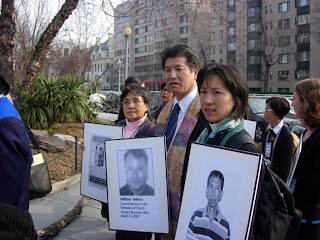 Washington D.C.
 The feeling was euphoric, almost elation. The hearing had come to a close- there was almost a collective exhale- a sigh and gasp of joy. As the crowd began to breath and chatter to break the silence, smiles broke out. Claps on the back, sighs of relief. "I started to cry during the hearing," said one friend, then another. “Me too,” I echoed, and we had to pause as the emotion of that moment was still powerfully present.
Something holy happened there in that moment. Tears are the language of God praying, they say. God’s prayers. Signs of holy presence. Hearings happen all the time; they are part of the bureaucratic political structure. It’s hard to measure exactly what will come out of it, or how immediately we will see any results in terms of an end to the political assassinations and accountability of the Armed Forces of the Philippines and U.S. military. There is much more follow up work to be done. We cannot yet say what the impact of it all is. But we can say that something holy happened there.
Rev. Mike Yoshii (who also attended this hearing) once mentioned at a retreat that his experience of the Congressional Hearings on Redress for Japanese Americans interned in WWII hearing was a pivotal spiritual experience for him. I think maybe I caught a glimpse of that. We always say that the spiritual is political, the political is spiritual. But still I didn’t expect a Senate hearing in the Nation’s Capitol with people dressed in suits and ties to be an experience of divine connection.
So what were those tears about? Perhaps they were tears of being heard. Not just by anyone - but tears that truth had been spoken and heard by the mighty and powerful. That somehow some "light had shined on the truth," as Senator Boxer said, as she commended the witnesses from the Philippines for doing the hard job of truth-telling when truth-telling can cost you your life.
Tears that some accountability was being administered. Hard questions were being asked of a State Department that dances around and hides, speaking in euphemisms about the U.S. war machine and the false democracy of our allies. Tears that the lies were being exposed. Tears that the story of the seven poor farmers massacred at dawn while working in their rice fields would be told here in the halls of the most powerful country in the world. That the senseless taking of their lives and the livelihoods of their surviving families would be lifted up at the same table where the State Department representative spun his web of half-truths. Life and truth would be spoken here. Just this act was so powerful.

Perhaps the tears were for of all those stories and individual lives lost and affected. We had heard testimony after testimony, report after report for a full day in the conference prior, yet somehow, the lives and spirits of the hundreds and their thousands of kin seeking justice filled the hall that day. Our tears were also for the delegation from the Philippines who have become our friends – and our fear and love as we say goodbye to them and they return to unknown conditions in the Philippines- where their protection is not guaranteed.
Towards the end of the hearing, Senator Boxer asked the witnesses testifying on the reality of the extrajudicial killings if they could ever recall a time in the past, a particular case, when the Philippine’s government was held accountable for its actions. First Marie from KARAPATAN, in her fragile voice, shook her head and said “No.” Followed by “No”, “No”, No” down the panel. Little more needed to be said.
A friend in attendance at the hearing, an immigrant from the Philippines said, “This is how the system is supposed to work," referring to the democratic process we had just witnessed. I am an ABC (American Born Chinese) so I take a lot of this for granted. I vote, but I am also more used to being on the outside of the political process – or at least the outside of the government buildings with signs, protesting and chanting. Maybe I thought that was where I felt most comfortable - because of my race, gender, political beliefs. I suppose that is where I assumed I would see and experience God- on the outside, not on the inside, engaging in the political process.
I have always been a critic of our so-called U.S. democracy that is so over-run by big-money and big business, cynical in thinking that all those letters and petitions that I sign do not really make a difference and that politicians don’t really care. Democracy and accountability in this country is a far cry from ideal, and even feels like a crapshoot sometimes, but it has been a powerful experience to see it at work, to see that it is possible, that we could have some access and recognition by our government leaders, and that justice did stand a chance.
There was something about that hearing process that reminded me of the New Testament story in Luke 5:17-21, the healing of the paralytic. Jesus is teaching and healing in a house, and a large crowd has gather, including the Pharisees and doctors of the Law who had come from every village in Galilee, from Judaea and Jerusalem. These were the powers-that-be, the top officials, the government leaders. A man who was paralyzed wanted to go to Jesus, to get close- perhaps he wanted to hear the teachings, to be healed, to be seen and touched by Jesus. But because of the crowds it was impossible. So with the help of his friends carrying him on his bed, they climb up on the roof and make a hole in the tiles and lower him down into the middle of the gathering in front of Jesus. Jesus is moved by their faith and the man is healed.
That’s a little of what it was like. There seemed to be no way to get in, to be heard by the powerful and mighty. So many issues and concerns, so many officials crowding the space and the airtime. Somehow we found a way to get into the halls of Congress. Like the healing story, it requires many, many hands and even unconventional measures. But as friends we will find a way to create a place inside. Just the getting there is holy in itself. Even if nothing more happened. But Jesus recognizes that faith, the man is recognized for what he is, not a paralytic, but as one who is faithful. How powerful, spiritually it is to be “recognized,” to be truly seen and known and understood- to be taken as one who can give witness and testament to the truth. How touching and healing it is for one to say, “Yes, of course, I see your pain and your suffering and your great faith. I recognize what is going on here. Come, welcome here into this place.” That happened in that hearing. When Senator Boxer understood what was being done in the Philippines, she said- “We don’t want another El Salvador here…we don’t want blood on our hands.”
To be heard and recognized by my government is part of that healing and holy moment. Isn’t that what our friends in the Philippines are asking of their government as well? That their cry for justice and the sanctity and worth of all people’s lives be recognized, that the ongoing economic and political suffering of the people be seen, acknowledged and truly addressed.
The hearing took place on the last day of the conference which was called, “A day of truth, reckoning and hope.” Indeed it was.
-Rev. Deborah Lee
March 14, 2007: Philippines Human Rights Senate Hearing. Reportback and video link.
 I just returned from Washington D.C. where I attended the International Ecumenical Conference on Human Rights in the Philippines and the Senate Hearing on Extrajudicial Killings in the Philippines. Many of you have attended some of our educational forums on this subject, received our emails, helped us to write letters, publicized and spread the word. Thank you! It has been such an exciting time since PANA has gotten involved with this issue at the Human Rights Day “ People’s Worship” or “Pagsambang Bayan” in Daly City on Dec. 10, 2006. Little did we realize that there was a powerful convergence of forces and Spirit about to take place. Bishop Eli Pascua and Rev. Tess Vertucio from the United Church of Christ Philippines spent one month in Northern California speaking at numerous venues about the issue; 17 members of the United Methodist Cal-Nevada conference were sent on a fact-finding trip to the Philippines in mid-February; during this trip, the U.N. Rapporteur, Philip Alston, issued his report on the Extra-judicial killings implicating the military, and then the Philippine's government finally released the conclusions of their own Melo Commission report which also pointed to the military as responsible for the killings.
In February, we began a flurry of legislative visits in Northern California with the strong participation of several Filipino-American pastors and community leaders; Our target had been Senator Boxer with the request of an official on-the-congressional-record Senate hearing in her new post as chair of the Asia Pacific subcommitee of the International Relations Committee. We had wanted this hearing to be March 12-14 when the delegation of religious and NGO leaders from the Philippines would be in DC to offer firsthand testimony. It was a bold request on a tight deadline and so we were not totally surprised despite our flurry of efforts when her office said “No.” But the activity did not cease, and on Thursday, March 8, 2007, just 4 days before the beginning of the Philippine’s Human Rights conference they changed their mind and said “Yes!” All those letters, the newspaper articles, the hundred of people with whom Bishop Pascua and Rev. Vertucio talked and met all over Northern California and Nevada, a significant letter by Rev. Bob Edgars, Pres. of the National Council of Churches, the work of many staff and lawyers working in the ecumenical denominational offices and D.C. law offices lobbying the aides and staffers- all put together worked! All of these activities and voices across the country and internationally converged. Every connection counted! I can remember a form letter to Barbara Boxer signed by a PSR alum who attended one of the educational forums. He wrote at the bottom in his own handwriting: "I met you at a wedding I officiated, please look into this serious matter."
So the official Hearing on Extrajudicial Killings in the Philippines was “ON” for March 14th- a victory in itself. But that was just the beginning of a dramatic few days leading up to the hearing. Within a span of less then a week, the Philippine government raided the home and sought to arrest leftist Philippine Senator Satur Ocampo as part of their political crackdown. He in turn announced that he was on his way to travel to D.C. to testify at the Hearing creating quite a stir. It was not really true, but a tactic to seek protection for himself- and it in turn put a lot of attention on the Hearings. Then, a day later, the Philippine's government and newspaper headlines read that the top two Military Generals and two Chief of Police were on their way to Washington D.C. to attend the hearings to “observe” and clarify "truth from propaganda." This audacity of the Philippine government significantly raised the tension and level of concern for the Philippine delegates at the conference, particularly, because during the span of the 3 day conference, 2 more activists were killed in the Philippines.
Fortunately, Senator Boxer’s office made it clear that there would be no intimidation or fear at the hearing and that Philippine Military and Police were not allowed to be at the hearing. (Whew!) Instead, the Philippine embassy attended and submitted a written report to represent the government’s views- a much more appropriate diplomatic response than sending the military!
During the hearing itself- Senator Boxer was brilliant and tenacious in challenging the State Department’s claims that the Philippines was a vibrant democracy, taking adequate measure to address the killings, painting a rosy picture of the situation. The others who testified were T. Kumar from Amnesty International, G. Eugene Martin from the Philippine Facilitation Project/U.S. Peace Institute, Bishop Eliezer Pascua from the United Church of Christ Philippines and Marie Hilao-Enriquez from KARAPATAN, a human rights group in the Philippines.
You can see the live footage of the hearing at the following link: http://foreign.senate.gov/hearings/2007/hrg070314p.html. (You may need to skip ahead 20 minutes for the actual start of the hearing.)
-Rev. Deborah Lee
Tuesday, March 20, 2007
Apr 3: "Redress, Reparations and Reconciliation" - Japanese American internment
Join us on April 3rd, 2007 6:30-9:30 for a Community Program on
“Redress, Reparations and Reconciliation”
the experience of Japanese American internment during WWII and its ongoing message for the present.
Film Showing : “Remembering Manzanar”
Speakers:
Dr. Joanne Doi, M . M . is a pilgrimage guide and teacher of the course "Manzanar: America's Internment," sponsored by the PANA Institute.
Rev. Michael Yoshii , long-time pastor of Buena Vista United Methodist Church, will share about his experience in the redress movement and its spiritual implications.
Members of
Location: Buena Vista United Methodist Church (Sanctuary)
2311 Buena Vista Ave.
Carpool Available : Leaving Pacific School of Religion at 5:45 pm ( Meet in the PANA driveway, 2357 Le Conte Ave.)
*This is part one of five sessions in preparation for the 38th annual pilgrimage to the former WWII site of Japanese American internment at Manzanar. For more information or to sign up for the pilgrimage, contact Shinya at pana2@psr.edu; 510-849-8226 or go to the PANA website: pana.psr.edu.
March 24 guided visit to Masjid Al-Noor in Santa Clara
Today is the last day to register for our March 24 guided visit to Masjid Al-Noor in Santa Clara, the largest mosque in California. We will learn about Muslim religious life, as well as social issues that concern Muslim Americans. In particular, we will discuss the effects of domestic terrorism directed at Muslims in the wake of 9/11.
Coordinated by Jaideep Singh, Visiting Scholar-in-Residence for the PANA Institute's Civil Liberty and Faith Project, and instructor of PSR course RSHR-1070: "Presumed Guilty: Race, Religion, and the Post-9/11 Racialized State"
Contact pana@psr.edu, 510-849-8244, to register.
Monday, March 19, 2007
March 7: Rev. Teresita B. Vertucio, United Church of Christ Philippines
You are invited to an International Women's Day Luncheon:
Join us at PANA for a lunch, presentation and discussion
Wednesday, March 7th
12:00 noon
Please RSVP
International Speaker:
Rev. Teresita B. Vertucio,
elected Conference Minister (Pastoral/Executive Position) of the
United Church of Christ Philippines
Northeast Southern Tagalog Conference
“Leaders yet Subordinate: The Place of Women Ministers in the Church”
This paper draws from Rev. Teresita B. Vertucio’s experience and research of the UCCP South Luzon Jurisdiction Area where women are ordained yet hardly stand on equal footing with male counterparts in terms of policy making and program initiatives of the church. The very low percentage of women who are having access to empowerment programs, and being yet unorganized, contribute to this status of subordination in a church that is patriarchal.
REV. TERESITA B. VERTUCIO was ordained minister of the United Church of Christ in the Philippines in 1987 after already serving as a Lay Pastor since 1980. She has a Bachelor of Theology from Union Theological Seminary Philippines (1978-1982), and Master of Arts in Religious Studies--Women & Religion (Thesis Writing) from 2002-2004. She had some involvement in GABRIELA Southern Tagalog (early 90's) and DIAKONIA, a women church workers’ organization (also in Southern Tagalog), which has both national and ecumenical character.
Please RSVP for the luncheon: contact Deborah Lee at dlee@psr.edu or 510-829-8260.
Subscribe to:
Posts (Atom)